


INTRODUCING THERCAST® NXT 3.1: ADVANCED CASTING SOLUTION FOR FASTER AND MORE RELIABLE NUMERICAL SIMULATIONS
This new version of THERCAST® NxT 3.1 brings a suite of improvements, advanced solver upgrades, and innovative features designed to optimize your metal casting simulations and enhance industrial productivity.
Whether you are a process engineer in foundry or steelmaking, a R&D professional, a simulation expert, or either you are a steelmaker or a metallurgist, THERCAST® NxT 3.1 is engineered to provide faster, more accurate, and more intuitive simulation workflows to help manufacturers overcome their constraints and industrial challenges. With this new release, THERCAST® positions itself as a key component, high-performance solution, empowering production teams to solve complex metallurgical issues, accelerating decision-making, and strengthening your competitive edge in an increasingly demanding market.

7 key priorities shaping industrial casting simulation
Over months of close collaboration with metallurgists, steelmakers, and foundry engineers, Transvalor has identified a set of recurring challenges shared across metal processing industries. These insights, gathered through daily exchanges, industrial projects, and user feedback, directly shape the development of THERCAST® NxT 3.1.
This release reflects what consistently matters on the shop floor and in R&D offices:
- Simulating a wider range of manufacturing processes with unmatched exhaustiveness.
- Boosting predictability with improved models and an expanded material database.
- Accelerating your workflows with enhanced efficiency and scalable algorithms.
- Working faster with a streamlined, intuitive interface designed for simplicity.
- Ensuring consistent results thanks to improved stability, bug fixes, and clearer documentation.
- Gaining full transparency by accessing and understanding the equations behind your simulations.
- Reducing your computational footprint with lighter storage and an integrated data-cleaning tool for more sustainability.
In this approach, Transvalor places value creation at the core of its strategy. Our commitment is to support manufacturers in achieving greater productivity, higher reliability, and superior performance, while providing solutions tailored to the specific needs of each industry. By adhering to these seven development pillars, our goal is clear: to equip every manufacturer with the tools needed to optimize processes, enhance result quality, and ultimately drive long-term profitability.
Discover the THERCAST® NxT 3.1 main features and improvements
Do you need to achieve higher accuracy and more reliable results across your casting simulations? THERCAST® NxT 3.1 introduces a powerful suite of new physics models and improvements designed to deliver greater precision, enhanced stability, and computational efficiency, particularly for large industrial castings.
High-Fidelity Solidification: Segregation & Sedimentation
Unlock a new generation of solidification insight: THERCAST® NxT 3.1 delivers sharper, more predictive modeling to help you control segregation and prevent defects before they occur.
- Segregation models: the solver offers an increased numerical stability of segregation computations, to deliver precise predictions in large domains (large ingots) while ensuring computation efficiency. This functionality helps improve the predictive accuracy of meso-scale phenomena at the macro-scale, while overcoming the constraint of prohibitive computation time, enabling robust segregation assessment for large ingots and heavy manufacturing applications.
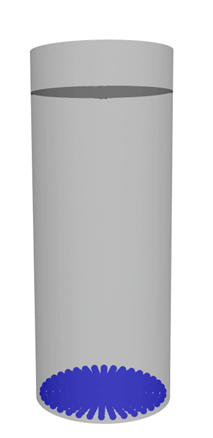
- Sedimentation prediction: THERCAST® NxT 3.1 now simulates the interaction of equiaxed grains with liquid metal during solidification. This full coupling with solute partition and transport makes it possible to estimate grain sedimentation and predict the formation of negative segregation cones, resulting in a more realistic representation of complex solidification phenomena in large castings.
Taking predictability to the next level: improved models and an expanded material database
Predicting material behavior is one of the most critical (and complex) parts of manufacturing processes. The new release strengthens your ability to anticipate component transformation with a series of massively upgraded models:
- Bubble and inclusion models: A more physical description of forces improves liquid metal-gas and metal-inclusion interactions. Newly added aggregation models allow realistic predictions of particle trajectories and clogging phenomena (e.g., SEN clogging in steel continuous casting).
- CET (Columnar-to-Equiaxed Transition): The Hunt criterion is now available directly in the GUI, enabling scalar-field visualization of transition zones as a fast and effective alternative to full CAFE simulations.
- Flow Rate Controls: Flow rate can now be automatically computed instead of manually defined, turning production time directly into a measurable and optimizable productivity result.
- Mold options: Open, semi-open, and porous molds are now supported. This brings the thermal and flow behavior in your mold closer to real industrial conditions, enhancing reliability.
Advancing quickness through solver and workflow optimization
Time is a critical resource. THERCAST® NxT 3.1 accelerates tasks across your simulation chain with optimized solvers, faster workflows, simple tools and scalable algorithms with these features:
- “Smooth” Meshing Tool: Now, creating meshes in THERCAST® NxT 3.1 has never been so effective. The Smooth tool repairs surface meshes with higher precision and enhances stability, enabling more reliable calculations on your complex geometries.
- ALE Solver: Unlock faster, smoother, and more stable continuous casting simulations with the Arbitrary Eulerian Lagrangian (ALE) solver. By cutting down remeshing operations and accelerating solid velocity calculations, it empowers you to run high-quality thermo-mechanical analyses for the prediction of defects and the design of mold taper and soft reduction in less time. Boosting productivity, ensuring greater reliability, and giving you a clear competitive advantage in your casting operations.
- Busy Loop Optimization: You are still able to set up your calculation in a row, and automatically the calculation starts when the previous one is completed. This part of the solver aims to improve your overall computational efficiency, reducing your simulation time and enabling an optimization of your licensing model.
- Multi-Object Parameter Definition: When you need to apply the same parameters (e.g. inital temperature, or material) to several objects, you can now do it with one click and simultaneously apply the changes to all of them, to speed up your setup workflow.
- Automatic Project Converter: With this new version, you do not waste time converting your past projects: the upgrade from version 3.0 to 3.1 is automatic. This is the end of rebuilding projects from scratch when the version changes.
Enhancing simplicity for better user experience
Simulation tools are powerful, but they must remain simple and intuitive. This version of THERCAST® streamlines user workflows to help you work faster.
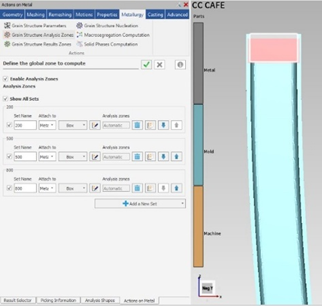
- CAFE Method: Your data preparation and visualization are easier thanks to a multi-zone storage made simpler, reducing setup complexity.

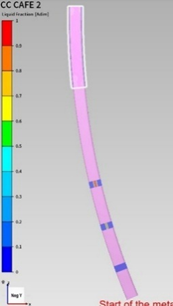
- Flexible Stage Orientation: Because everyone has their own perspective and working methods, the adaptive orientation of thestages in your simulation project makes it easier to visualize the project structure. You can now choose either horizontal or vertical view in your process setups. This will provide a clearer view of complex projects with multiple variants: an essential advantage in simulation workflows.
- Customizable Scales: Reading your results is now easier to interpret and analyze thanks to the customizable scales. You can edit the legend labels, modify the values and add text instead. For instance, the information about the temperature of the material can either be labeled with your own words to indicate key alloy temperatures, such as liquidus and solidus, following your own technical constraints, preferences or terminology specific to your industry.
- Depth Plot Tool: This new analysis tool allows you to trace values for temperature, hardness, or any result field according to a point, depth and direction. This improvement will ensure you a more detailed indicators within depth and direction: creating a profile/length plot has never been so intuitive.
Greater stability for consistent results: resolved bugs and clearer documentation
Because your time is precious this release focuses on the stability of your computations. It offers clearer guidance and eliminates bugs to support both productivity and accuracy.
- Material Data Tool Refactoring: Fixing recurring bugs was one of the most obvious improvements in this version, debugging and simplification for a smoother experience during your simulation.
- Expanded Tutorials: In this version, you can access new and improved tutorials covering new applications, such as electromagnetic stirring in continuous casting, metal flow in continuous casting tundish, and other modules. This evolution of the library aims to enrich your resources and guide you closely in your simulation activities.
- Thermo-Mechanical Calculations: combine thermal, flow, and solid deformation effects to accurately predict metal contraction during solidification. In certain casting conditions, this contraction can create internal voids known as shrinkage. In THERCAST® NxT 3.1, numerical improvements stabilize the internal shrinkage computation, ensuring more reliable and realistic predictions.
Greater transparency for better decision-making
To empower engineers and manufacturers with full control, THERCAST® NxT 3.1 increases transparency in the way equations and models are presented.
- Calculation Options Refactoring: the dialog was fully reviewed to present clearer options for thermo, thermo-hydraulic, and thermo-mechanical simulations. You have now a clear vision of all the software will do for each option.
- Improved Error Messages: The content of your error message is made clearer in this version; it makes faster troubleshooting with improved message clarity.
Specific Tool for the Steelmaking Industry: The Continuous Casting (CC) Tool
The Continuous Casting Tool (CC Tool) (lien vers page process CC) was designed and improved specifically to meet your needs in the steelmaking industry, where precision, efficiency, and rapid iteration are critical.
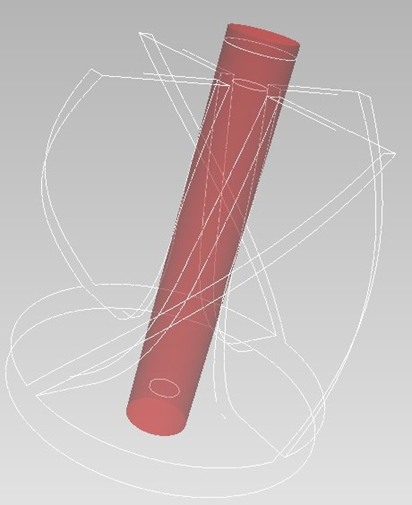
With this tool, you can now modify the machine layout directly from the graphical user interface (GUI) in just a few clicks, adjusting rolls and sprays positions and geometrical features, cooling parameters, and other key components: all in view mode. This eliminates the need to manually edit complex text input files, significantly reducing setup time and minimizing the risk of errors.
The CC Tool is particularly valuable for equipment designers and R&D engineers, allowing them to quickly test many variants of layout modifications. By providing intuitive, “real-time” control over continuous casting configurations, the CC Tool helps to consider every machine modification and fit with the reality in few clicks.
For a deeper demonstration of its capabilities, you can watch the webinar replay to see the tool in action or ask for a demo/service.

Specific Tool for the Metal Casting Industry: Lost Foam Simulation
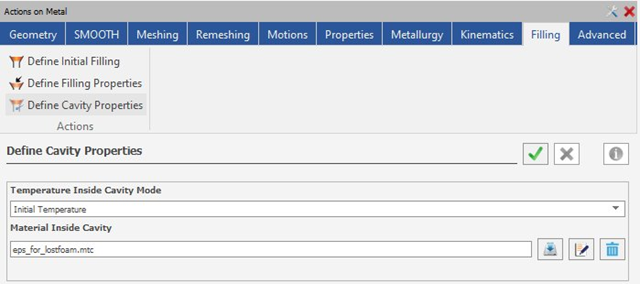
The Lost Foam model in THERCAST® NxT 3.1 brings a powerful simulation solution tailored for the metal casting industry. THERCAST®’s Lost Foam simulation accurately captures the interaction between the molten metal and the foam pattern, providing you with precise predictions of flow behavior, solidification, and potential defects.
This enables foundries to reduce scrap and improve part quality while maintaining flexibility for complex geometries and intricate shapes. By integrating this simulation directly into your workflow, the Lost Foam model helps you achieve higher precision, better consistency, and more reliable production outcomes. The Transvalor teams is still working on every step of this particular process and THERCAST® will provide soon more models concerning induction and sand behavior during shaking.
Sustainable computing: reduce storage and streamline projects
Sustainability is at the heart of all concerns when it comes to not only to manufacturing, but also to simulation. THERCAST® NxT 3.1 presents a more sustainable version with an optimized storage environment.
- Cleaner Tool & Archiving Tool: this new tool allows you to maintain leaner projects, avoiding unnecessary storage in your database. In other words, you can store past projects selecting the important data only. This limits your storage only to essential information.
- Storage management customization: you can now choose between essential storage, restartable storage, and full storage options for reduced memory usage.
With THERCAST® NxT 3.1, industrial teams gain a comprehensive, high-performance simulation environment designed to meet the most demanding challenges in metal casting and solidification. This release brings together enhanced predictive models, optimized solvers, streamlined workflows, and intuitive tools, enabling engineers, metallurgists, and foundry professionals to anticipate defects, accelerate decision-making, and increase process reliability.
By combining greater accuracy, computational efficiency, and transparency with simplified user experience and sustainable computing, THERCAST® NxT 3.1 empowers your teams to master complex metal transformation phenomena, optimize production processes, and drive consistent, high-quality outcomes.
With this release, Transvalor reaffirms its commitment to providing industrial-grade solutions built on scientific rigor and real-world insights, giving your organization the precision, control, and efficiency needed to innovate confidently and stay competitive in an evolving manufacturing landscape.
Join our newsletter to receive the latest updates and webinar invitation

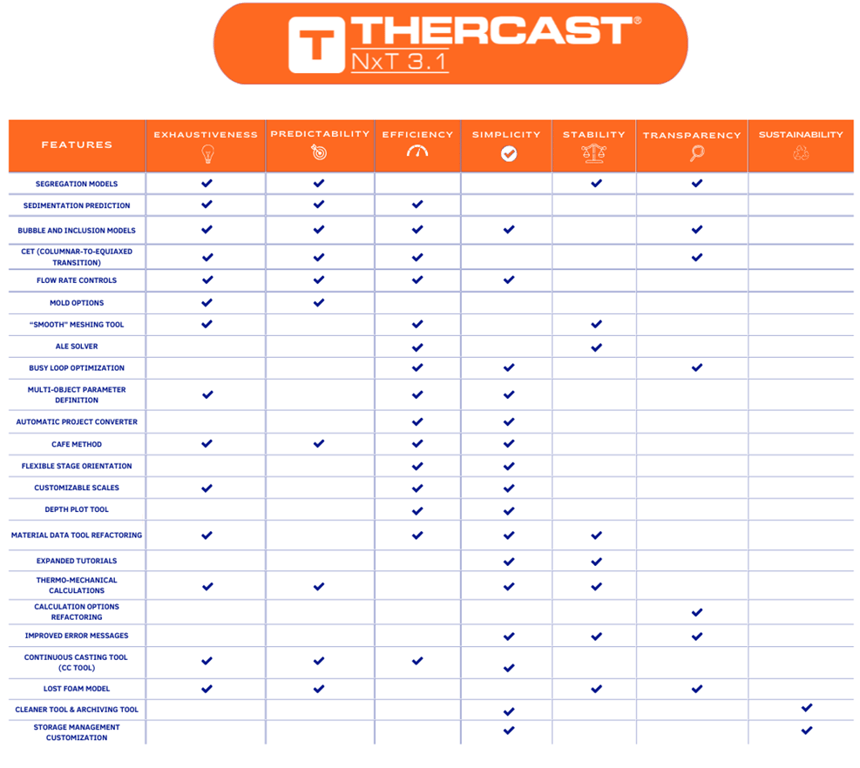
Features’ synthesis
