








image (12)2

Numerical simulation at the heart of the Defense industry

The defense industry operates in an environment defined by strict safety requirements, complex systems integration, and rapidly evolving technological demands. Equipment must perform reliably under extreme conditions while meeting rigorous certification standards and tight development timelines. Advanced simulation has become essential to address these challenges, enabling engineers to predict performance, optimize designs, reduce physical testing, and accelerate innovation while ensuring mission readiness and operational reliability.


Request a demo

Your main challenges

Developing and qualifying defense components is a complex, high-stakes endeavor involving:

quality

Ramp up your production rates

Refining your manufacturing processes to achieve higher production volumes with minimal scrap parts. 

006-industrial-robot-1

Tight development cycles

Intensify the development of manufacturing processes for every lighter components as wells as for metallic materials (aluminium, HSS steel) than composite materials.

024-solar-panel

Material performance uncertainty 

Assessing how a material behaves after forging, heat treatment, or machining, and how that affects its dynamic response, is critical yet difficult to evaluate. 

quality_costs

Fatigue and durability 

Repeated mechanical or thermomechanical loading cycles make fatigue life prediction a key design requirement 

041-conveyor

Extreme loading conditions

Components must withstand impact, blast, and shock loads at strain rates far beyond conventional structural applications.

050-anvil

Limited experimental access

Full-scale blast or ballistic tests are costly, logistically complex, and provide limited insight into internal stress states and damage mechanisms. 

user_interaction

Manufacturing-to-performance traceability 

Ensuring that the fabrication process does not compromise the mechanical integrity of the final component under operational loads 

We meet your challenges

Our simulation solutions address the full complexity of defense component development, from fabrication to in-service performance assessment.

From manufacturing to dynamic performance: FORGE® simulates the complete fabrication chain (including heating, forging, drawing, flowforming and heat treatment,s among others opertaions) and directly transfers the resulting material state into dynamic analyses. Residual stresses and work hardening inherited from manufacturing are fully accounted for when assessing components such as artillery shells, armor plates, or structural brackets under operational loads.

High strain rate and dynamic simulation

 Supporting advanced rate-dependent constitutive models such as Johnson-Cook, FORGE® enables accurate simulation of material behavior under extreme dynamic loads. Deformation, stress localization, and failure mechanisms in components such as projectile cores or ballistic protection panels can be reliably assessed. 
FORGE_steering_knuckle_simulation

Forge svg (1)

FORGE® is a simulation software dedicated to hot-, warm- and cold forging processes.

Colform svg (1)

COLDFORM® is a simulation software dedicated to cold forming processes, and particularly suitable to manufacture fasteners. Designed on the basis of FORGE® software, it benefits from exactly the same level of reliability and robustness.

Blast and explosive loading

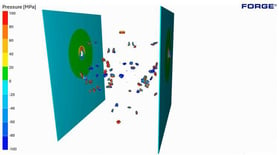
 FORGE® can be extended to simulate pressure field evolution, stress wave propagation, and fragmentation risk under explosive loading. Its automatic remeshing engine ensures numerical stability throughout the large deformations encountered in such configurations, which is a critical requirement for this class of problems.

Thercast svg (1)

THERCAST® is software dedicated to foundry parts regardless of the casting technology used. It is particularly effective for low-pressure or vacuum casting of parts in aluminum alloy.

Fatigue life prediction with Z-set

 FORGE® results chain directly into Z-set for fatigue life assessment in the actual post-manufacturing material state. For cyclically loaded components such as rotor hubs or weapon system structural elements, this integrated approach delivers significantly more accurate durability predictions.

REM3D_seat_base


Rem3d svg (1)

REM3D® simulates the injection processes for both traditional thermoplastics and reinforced plastics. REM3D is also one of a kind for simulating the chemical foaming process, simulating the phase of depositing PU foam followed by the expansion of the mixture by exothermic chemical reaction. This gives you access to the foam density mapping at any point of the molded component.

Case study MBDA

Challenge

MBDA produces thin-walled, high-strength aluminum tubes using a flow forming process with a mandrel, rollers, and tailstock, a precise technique requiring exceptional skill.

Solution

MBDA combined experimental tests and 3D FORGE® simulations to predict forming forces, residual stresses, and mechanical properties of aluminum tubes with high precision.

MBDA

Testimonial

“ […] The work carried out allowed the validation of the choices made in the workshop and a better concieving the loadings applied on the material. […]”

Agathe  Demay, Technical specialist process simulation, France
Download the case study