



Introduction
Modeling and simulation have become key tools for the engineering and manufacturing of complex defense systems1,2. In an increasingly unstable geopolitical environment, faster improvement of systems design becomes essential, with tighter budgets and fewer opportunities for full-scale physical testing. As a result, the defense sector increasingly relies on numerical tools to support engineering decisions and to optimize the manufacturing processes of critical components used in ammunitions, firearms, missile systems, military vehicles, aircraft and naval platforms3-6.
Many defense components are produced through metal forming and thermomechanical processing of high-strength alloys. Manufacturing routes such as drawing, extrusion, flow-forming, rotary forging and closed-die forging involve very large plastic deformation, complex contact conditions and strong thermal effects. Controlling material flow, strain localization and defect formation during these operations is critical to ensure dimensional accuracy and mechanical reliability7.
The finite element method (FEM) has therefore become a key tool for analyzing forming operations and predicting material behavior during processing. Numerical simulations allow engineers to evaluate strain and temperature fields, forming loads, residual stress levels and possible defect formation before industrial implementation8. Transvalor’s solution FORGE® was specifically developed for the simulation of metal forming processes involving large plastic strains and strong thermomechanical coupling. Its 2D axisymmetric and 3D FEM framework, its ALE formulation and its advanced contact and remeshing strategies are tailored to complex industrial forging, extrusion and flow-forming applications6,9. These capabilities make it well suited for analyzing and optimizing forming processes involved in the production of metallic components used in the defense sector.

Simulation in Defense Component Manufacturing
Turbine disks, compressor blades, shafts, and casings in military aircraft engines are made from nickel-based superalloys or titanium alloys and must perform reliably under extreme mechanical and thermal stresses. Manufacturing these components involves precision forging, machining, and heat treatments, with strict requirements on microstructure, surface finish, and fatigue resistance as well as very narrow forming temperature windows.
FORGE® simulations model forming, heat and thermochemical treatment processes, predicting material flow, thermal gradients, residual stresses, and microstructural evolution. Its continuously updated material database ensures accurate modeling of both established and emerging alloys. For fatigue-critical components, FORGE® results can be chained with Z-set (Figure 1) to evaluate operational loading and long-term durability, providing a complete workflow from manufacturing optimization to in-service performance prediction.
.png?width=583&height=233&name=image%20(23).png)
Figure 1: FORGE® – Z-set global lifecycle simulation chain of a turbine disc.
While aircraft components must withstand prolonged high-temperature and mechanical stresses, artillery shells face extremely intense, short-duration loads during firing. The casings are formed from alloy steels through forging, drawing, or flow-forming, then machined, honed, and polished to achieve precise dimensions and aerodynamic smoothness. Heat treatments ensure the necessary hardness and toughness. Each stage introduces potential challenges, including uneven wall thickness, folding, or residual stress development.
These challenges can be addressed through FORGE® simulations (see Figure 2) that help predict stress, strain, and temperature distributions during forming, revealing areas at risk of thinning or deformation (see the work of Kocabıçak et al. on the simulation of the flowforming process with FORGE®). By virtually adjusting die geometry, forming sequence, or process parameters, engineers can reduce defects and improve uniformity of shells. FORGE® simulations can also estimate residual stresses and microstructural evolution, providing insight into the projectile’s structural integrity under operational conditions.
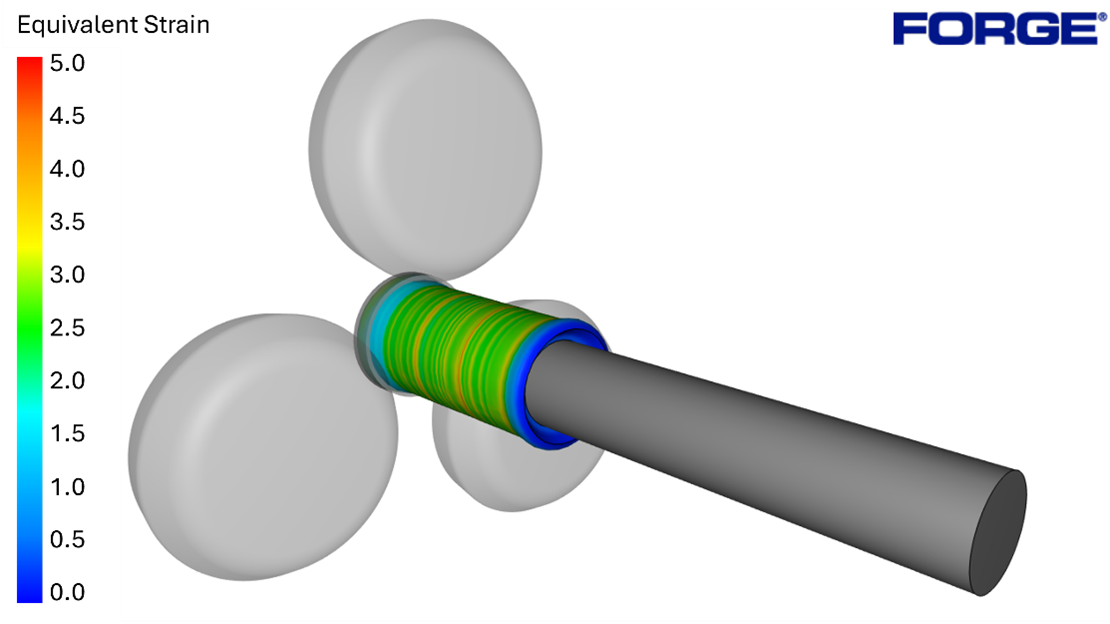
Figure 2: Flowforming of a tube simulated with FORGE®.
Smaller precision components, such as firearm receivers, bolts, and barrels, present a different set of challenges. These parts are typically produced from high-strength steel or aluminum alloys using forging, machining, and heat treatment, with tight tolerances that are critical for repeated firing reliability. Forging is especially favored for receiver components because it enhances material properties via improved grain flow and reduces waste compared to machining from solid billets.
Simulation with FORGE® allows engineers to analyze material flow and temperature distribution during die closure, which is critical because excessive temperatures can compromise surface quality and mechanical performance. An illustrative example is presented in a video10 published by « Armi Militari », showing a FORGE® simulation of an aluminum lower receiver billet and how temperature evolves across the material as the dies close. These virtual analyses allow optimization of process parameters, die design, and billet preparation to ensure dimensional accuracy, material integrity, and overall component quality.
Conclusion
While this article highlighted applications such as firearms, artillery shells and engine parts, the potential of software like FORGE® extends across the full spectrum of defense manufacturing, from small precision parts to large-scale weapon systems. By leveraging discrete-event simulation and tool-wear prediction, manufacturers can uncover production bottlenecks, optimize machine allocation, streamline scheduling, boosting throughput and component reliability without compromising quality.
FORGE® has already proven its accuracy and reliability across numerous metallurgical applications with a broad base of industrial clients. Defense manufacturers can exploit these capabilities in the most demanding environments, gaining a clear strategic advantage in both cost and performance.
References
- R. Guajardo et al. "Systems Engineering Modelling and Simulation to Support Defence Acquisition System." Hadmérnök (2020). https://doi.org/10.32567/hm.2020.3.2.
- Alexandru Cotorcea et al. "Using modeling and simulation to optimize naval defense systems." Scientif Bulletin of Naval Academy (2024). https://doi.org/10.21279/1454-864x-24-i2-023.
- Tech. Sgt. Robert Cloys. "Modeling and simulation allows weapon system to be explored in extreme without physical risks". Air Force Test Center (2025). https://www.torch.aetc.af.mil/News/Article-Display/Article/4182196.
- G. Kishan. "Digital manufacturing technologies for missile development". Manufacturing Technology Today, 19(12), 34–37(2020). http://www.mtt.cmti.res.in/index.php/journal/article/view/99
- E. Brusa et al. "Virtual engineering of a naval weapon system based on the heterogeneous simulation implemented through the MBSE". Innovation, 10, 12 (2018). https://ceur-ws.org/Vol-2248/paper5.pdf
- O. Markov et al. "Testing a new technique for producing artillery cartridge cases from pipe workpiece by roughing with a friction tool." Eastern-European Journal of Enterprise Technologies (2023). https://doi.org/10.15587/1729-4061.2023.291881.
- Acar Can Kocabıçak et al. "Multiphysics numerical modelling of backward flow forming process of AISI 5140 steel." Simul. Model. Pract. Theory, 121 (2022): 102656. https://doi.org/10.1016/j.simpat.2022.102656.
- Doltsinis et al. "Computer simulation of industrial metal forming processes." Large Plastic Deformations (2021). https://doi.org/10.1201/9780203749173-6.
- J. Chenot et al. "Finite element modelling of forging and other metal forming processes." International Journal of Material Forming, 3 (2010): 359-362. https://doi.org/10.1007/s12289-010-0781-5.
- https://www.youtube.com/watch?v=Orf2Rb4-7mE
