


INTRODUCTION: REM3D® for mastering polyurethane foam simulation
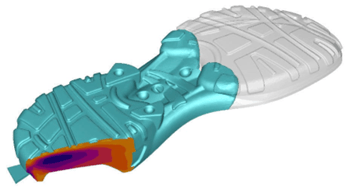
REM3D® is a dedicated simulation software designed specifically for polymer processing, with a strong focus on polyurethane foams.
It enables engineers to simulate the full manufacturing chain, including:
- Injection and mold filling
- Material expansion and foaming
- Final part properties and performance
The objective is clear: no surprises in production: only predictable, optimized results.

A methodology driven by experimental accuracy
One of REM3D®’s core strengths lies in its physics-based, data-driven methodology.
Because polymer foams exhibit complex and highly sensitive behaviors depending on their formulation, a precise material characterization phase is required. This experimental data is then used to define a constitutive law.
Advanced simulation capabilities for industrial needs
REM3D® integrates a wide range of advanced features designed for real industrial environments:
- STL-based geometry handling for complex parts
- Adaptive remeshing to optimize accuracy and computation time
- Precise definition of injection conditions (flow rate, trajectory, stop criteria)
- Multi-material simulations
- Virtual molds to reduce computational cost
- Bubble tracking and defect prediction tools
A key advantage is its intuitive interface, which guides users by highlighting missing or inconsistent parameters, ensuring robust setup and faster workflows.
Understanding and controlling bubble formation
A central challenge in foaming simulation is air bubble entrapment, which can severely affect product performance.
REM3D® allows engineers to track bubble formation and movement in real time, providing deep insight into defect mechanisms.
One industrial example discussed during the webinar highlights electronic encapsulation, where bubble control is critical to ensure device reliability.
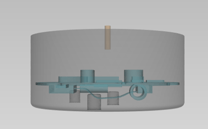
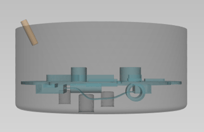
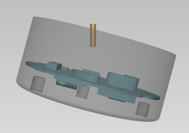
Three injection strategies were compared:
- Central injection
- Inclined injection
- Tilted mold injection
The results clearly show that tilted injection significantly reduces bubble entrapment, demonstrating how simulation can directly guide process optimization.
From visualization to process optimization
Beyond bubble tracking, REM3D® enables engineers to analyze:
- Viscosity evolution during foaming
- Temperature distribution in the mold and part
- Exothermic reactions during solidification
- Interaction between process conditions and material behavior
Advanced tools such as cutting planes, mesh visualization, and adaptive mesh refinement provide a detailed understanding of what happens inside the part during the process.
CONCLUSION: precision replaces uncertainty
As demonstrated throughout this webinar, REM3D® transforms foaming simulation into a controlled, predictable, and optimized engineering process.